7 Trading Confluences That Turn a Raw Setup Into a High-Probability Entry
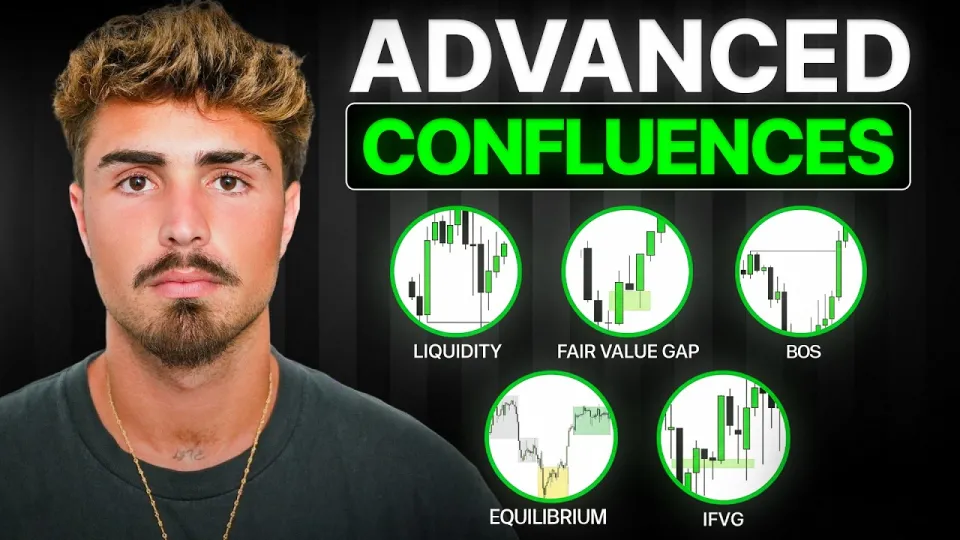
Video: Learn Every Trading Confluence In 18 Minutes
Want articles like this for your own video to promote it on YouTube and Google? Order them through the Telegram bot @sat_sit_bot. The bot writes and publishes the articles itself (with your YouTube video embedded) on popular topical websites (no ads). Try it free: 50 articles on us.
· based on the channel TJR
Key takeaways
- Confluence means two or more independent signals agreeing on the same price zone, direction and timing.
- The core toolkit in the TJR breakdown: liquidity, fair value gaps (FVG), inverse FVGs, equal highs/lows and break of structure (BOS).
- A confluence is only useful if it fits your written strategy — stacking signals that contradict your risk rules adds noise, not edge.
- Most retail day traders lose money; no confluence set removes the need for a stop loss, position sizing and a journal.
- The free TJR Blueprint link is the starting point for building a repeatable process rather than copying single setups.
Trading confluences are the independent signals — liquidity sweeps, fair value gaps, inverse FVGs, equal highs and lows, break of structure — that line up on the same price zone, direction and timeframe and justify a single entry. The practical rule is simple: the more of these factors agree without contradicting your risk plan, the higher the probability of the setup, and the fewer you can confirm, the smaller the position or the more reason to skip the trade entirely. TJR's 18-minute walkthrough of every confluence is a useful checklist to build on, and the free system behind it is available through the TJR Blueprint.
What a confluence actually is in trading
A confluence is agreement, not decoration: it is the moment several unrelated market facts point at the same decision. Price sweeping a prior high, leaving a fair value gap behind, then breaking structure in the opposite direction is a confluence because each element was produced by a different mechanism — stop hunting, imbalance, and a shift in the auction — and they happen to align. Three indicators derived from the same moving average are not a confluence; they are one signal wearing three hats. That distinction matters because stacked, correlated tools create the feeling of confirmation while adding no new information, which is exactly the trap the most-liked comment under the video warns about: the real skill is knowing which confluences add value to your strategy.
A workable definition for a trading plan: a confluence is a factor that (1) can be observed objectively on the chart, (2) has a defined invalidation level, and (3) changes your probability estimate enough to affect position size. If a factor fails any of the three, it belongs in your notes, not in your entry criteria.
The core confluences TJR walks through
TJR's breakdown covers the price-action toolkit most modern intraday traders use, and each element earns its place because it describes a different part of the same story.
- Liquidity. Clusters of stop orders sit above equal highs and below equal lows, and around obvious swing points. Price often trades into those pools before reversing, so a sweep of an obvious level is a location signal rather than a direction signal on its own.
- Fair value gap (FVG). A three-candle imbalance where the wicks of candle one and candle three do not overlap. It marks an area where price moved too fast for both sides to trade, and it frequently acts as a magnet or a reaction zone on the return.
- Inverse FVG. When price trades through an FVG and then respects it from the other side, the gap flips role — former support becomes resistance, or the reverse. It is one of the cleanest ways to see a failed move turn into a continuation.
- Equal highs and equal lows. Two or more highs (or lows) at nearly the same price signal engineered liquidity. Traders treat them as targets to be swept, not as resistance to be respected.
- Break of structure (BOS). A close beyond a meaningful swing point that confirms the current leg has shifted. A BOS after a liquidity sweep is the confirmation half of the classic sweep-and-reverse sequence.
None of these is a strategy by itself. Liquidity tells you where, an FVG tells you where the imbalance is, a BOS tells you when the shift happened, and your stop placement tells you whether the trade is affordable.
How to stack confluences into one trade plan
Stacking works best as a fixed sequence rather than a shopping list, because a sequence forces you to wait for confirmation instead of hunting for reasons to enter. A practical order for intraday trading:
- Bias first. Decide from the higher timeframe (daily or 4-hour) whether you are looking for longs or shorts. Confluences that fight your bias get ignored.
- Location second. Mark the liquidity pools, equal highs and lows, and the nearest unfilled FVGs. You are building a short list of zones where you are willing to act.
- Trigger third. Wait for price to reach the zone, sweep the liquidity, and print a break of structure in your direction. Only then is the setup live.
- Entry and invalidation together. Enter at the FVG or the inverse FVG left by the shift, with the stop beyond the sweep. If the distance to the stop makes the position too large for your risk per trade, the trade is too expensive — not the stop too tight.
- Target the next pool. The opposite liquidity level is the default target; anything beyond it needs a fresh reason.
Two or three of these aligning is usually enough. Requiring all five on every trade produces very few entries and a lot of frustration, while requiring only one turns the method into a coin flip with extra steps.
Confluence versus confirmation bias
The most common failure with confluences is retrofitting them: entering on impulse and then finding three reasons the chart agrees. The antidote is to define your minimum confluence count before the session and write it down. If your rule is "liquidity sweep plus BOS plus an FVG entry," then a beautiful equal-highs pattern with no sweep is a no-trade, no matter how good it looks in the moment. A trading journal — TJR uses and recommends TradeZella for this — turns the question from "did this feel like a good setup?" into "which combinations actually paid across 50 trades?" That data is the only honest way to learn which confluences carry weight in your market and session.
The questions traders ask about confluences
Viewers of the breakdown raise the same practical doubts that come up in every trading community, and they deserve direct answers rather than motivational ones.
"How many confluences do I need?" Enough that the setup clears your own backtested threshold. For most discretionary intraday traders that lands at two or three independent factors. More than that and you will sit out most of the week.
"Do confluences work on any market?" The mechanics — liquidity, imbalance, structure — exist in futures, forex, crypto and equities because they come from order flow, but the reliability of each one varies by session and instrument. Test on the market you actually trade.
"Why do I still lose with a good checklist?" Because execution, sizing and discipline sit outside the checklist. Losing money early is close to unavoidable; the traders who last are the ones who keep showing up, keep records and stay off the comparison treadmill of social media, where only the winning screenshots get posted.
"Can I skip the losses?" No. The market is heavily manipulated in the short term and will often do the opposite of the crowd's expectation, which is precisely why location-based confluences beat prediction. Risk management is what lets you survive being wrong.
Useful links from the breakdown
- TJR Blueprint — the full system for becoming a consistently profitable trader
- Indicators TJR uses daily
- Funded account raffle entry
- Alpha Futures funded accounts — 10% off
- Lucid Trading — 40% off
Final thoughts on building a confluence-based process
Confluences are a filtering tool, not a prediction engine: they tell you when several independent facts about price agree, and they tell you when to stand aside. The five elements TJR covers — liquidity, fair value gaps, inverse FVGs, equal highs and lows, and break of structure — are enough to build a complete intraday plan if you fix the sequence, define invalidation before entry, and record every trade. Expect the learning curve to cost money; the traders who make it are the ones who treat that cost as tuition and keep showing up. If you want the structured version of this process, start with the TJR Blueprint and treat the channel's breakdowns as the map rather than the destination.
Source: Learn Every Trading Confluence In 18 Minutes · Markdown version
Questions & answers
What is a trading confluence in simple terms?
A confluence is two or more independent signals pointing to the same decision — for example a liquidity sweep, a break of structure and a fair value gap all lining up at one price zone. The signals must come from different mechanisms; three variations of the same indicator do not count.
How many confluences should a trade have?
Most discretionary intraday traders work with two or three independent factors, because that keeps enough setups available while filtering out noise. The right number is the one your own recorded results support, not a number copied from someone else.
Do fair value gaps and inverse FVGs work in crypto and forex too?
Yes, because they describe imbalances in order flow rather than a property of one market. Their reliability still varies by instrument, timeframe and session, so test the same rules on the market you actually trade before risking real size.
Why do traders still lose money when they use confluences correctly?
Because a checklist covers entries, not execution: position sizing, stop discipline, emotional control and record-keeping decide the outcome. Day trading is risky and most day traders lose, so treat early losses as a cost of learning and keep a journal to separate bad luck from bad process.